
Habsburg Castle

Virtual Habsburg Castle

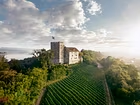
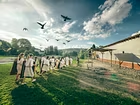
Virtual flight with VR glasses Admission Entrance free Booking required Book your time slot conveniently online. Please note The VR headsets are available at the visitor centre between April and October. Fly over Habsburg Castle as it was in 1200 Put your VR glasses on for an adventurous 360-degree flight over the castle in around the year 1200. Enjoy a bird's eye view of the site and immerse yourself in the world of the 13th century Habsburgs! Virtual Habsburg Castle: Fly over Habsburg Castle as it was in 1200

 
Lenzburg Castle

Children's museum and PLIRRK!

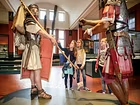
Children's museum and PLIRRK! Admission Museum entrance fee Notice The craft area closes at 4.30 pm. Children must be supervised. The paradise for knights and princesses! Children's museum The children's museum is located right up in the attic of Lenzburg Castle. There are lots of secret nooks and crannies, hidden staircases and oriels to explore. Children can dress up as knights or princesses, chase around the corridors and practise handicrafts and painting to their heart's content. Children's exhibition PLIRRK In the children's exhibition PLIRRK!, kids can immerse themselves in the world of

 
Egliswil Collection Centre

Guided tours and events

The Egliswil Collection Centre is not open to the public. From February to December a public guided tour takes place on the first Tuesday of each month. Event calendar (in German) Contact +41 (0)848 871 200 Send a message Telephone availability: Tuesday to Friday 9 am - 12 pm / 1 pm - 4:30 pm November to March only in the morning

 
Wettingen Abbey

Guided tours for groups

Wettingen Abbey offers guided tours for groups. On request, they can also be organised in French. Offers for groups (in German) Contact +41 (0)848 871 200 Send a message Telephone availability: Tuesday to Friday 9 am - 12 pm / 1 pm - 4:30 pm November to March only in the morning

 
Lenzburg Castle

Domestic life museum and prison

Permanent exhibition Admission Museum entrance fee The museum of domestic life and prison reveal the lives of lords, rogues and scoundrels. The museum of domestic life and prison of Lenzburg Castle reveal the lives of lords, rogues and scoundrels. Come and explore! Domestic life museum: how lords and ladies lived In the museum of domestic life it feels as if the lords and masters had just left Lenzburg Castle. Filled with original furniture, it provides an insight into the different eras in which the castle was inhabited. In the late medieval kitchen, for example, you can look into the cooking

 
Lenzburg Castle

Knighthood and Nobility

Permanent exhibition Admission Museum entrance fee The "Knighthood and Nobility" exhibition focuses on the Middle Ages. Medieval fans will find plenty to interest them in the "Knighthood and Nobility" exhibition: discover how three great Swiss noble families organised their rule and the legacy they left behind. From the 11th to the 15th century, the Lenzburgs, Kyburgs and Habsburgs ruled Lenzburg Castle. This 400-year history of rule is presented in the residential and south tower, the oldest part of the castle. Audiovisual shadow plays show how the three great noble families fought out conflicts

 
Lenzburg Castle

Fauchi and the dragon research station

Permanent exhibition Admission Museum entrance fee Visit Fauchi, the castle dragon! What would Lenzburg Castle be without Fauchi! The castle dragon is loved by all young visitors. At the dragon research station you can find out all about the castle's legendary inhabitant. Fauchi: are you brave enough? Anyone with enough courage can visit the castle dragon Fauchi at Lenzburg Castle. Enter his dark cave full of hissing, smoke and ominous rumbling. It's an unforgettable experience for castle visitors of all ages! According to legend, the castle dragon Fauchi hatched from a dragon egg many years ago on

 
Wettingen Abbey

Observatory

Permanent exhibition Admission Museum entrance fee Take a journey through the history of knowledge and belief At the Observatory, take a journey through the history of knowledge and belief in a cinematic installation. Together with a group of pupils from Wettingen Cantonal School, you will visit places that tell this story: from the earliest known cave paintings to the vastness of the World Wide Web. On this journey, you will discover how the monks of the Cistercian abbey understood knowledge in the Middle Ages – and how the expulsion of the monks from the abbey in 1841 was linked to new concepts

 
Wettingen Abbey

Medicinal garden

Admission Free of charge Tradition of monastic healing Today, medicinal herbs, spices, flowers and also certain vegetables grow in the medicinal garden of Wettingen Abbey. The garden showcases the long tradition of monastic medicine. The original location and design of the medicinal garden are not known in detail. It is assumed that, as in comparable abbey complexes, the Wettingen garden was located by the infirmary wing. The garden has been reconstructed at this location, based on the Hortulus book on gardening by the Reichenau abbot Walahfrid Strabo and the St. Gallen abbey plan from the 9th

 
Wettingen Abbey

Cloister garden

Admission Museum entrance fee Idyllic garden in the heart of the abbey complex Experience a special monastic atmosphere in the cloister garden of Wettingen Abbey: the idyllic garden with its meadow, yew tree, water basin and path is located within the abbey walls and surrounded by the cloister quadrangle. Throughout the ages, the cloister garden was designed as a spiritual garden with a central solitary tree. In monastic culture, the tree is reminiscent of the forbidden tree of knowledge in the Garden of Eden. On the other hand, it stands for life, as a symbol of Christ and the cross. Today's

Gradian
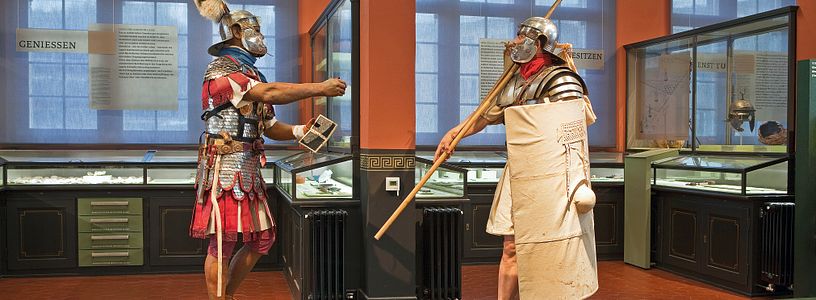
Ausstellung von zwei Legionären im Vindonissa Museum

Accessibility

Visiting with disabilities

Visiting with disabilities

We are happy to assist people with a disability on their visit to the Vindonissa Museum. However, the historic building is not barrier-free.

Getting here

Parking spaces for people with reduced mobility are available at the Eisi multi-storey car park in the centre of Brugg. The short distance to the Vindonissa Museum is flat.

Getting here

From Brugg railway station there are bus lines to the "Brugg, Eisi" stop. From there it is about 3 minutes to the Vindonissa Museum; the path is free of obstacles.

Getting here

Access to the museum

At the main entrance, steps lead into the museum that cannot be bypassed. There is no lift in the building, so all floors can only be reached via stairs.

  • Wheelchair users: The Vindonissa Museum is not suitable for people with reduced mobility.
  • Blind and visually impaired people: The rooms are brightly lit and contrast is good. There is no Braille labelling.
  • Hearing impaired: There is no induction loop system available. Printed information is available for all exhibitions.
  • People with intellectual disabilities: There are no labels in simple language.

Museum and exhibitions

Toilets are located in the basement of the museum and can only be reached via stairs.
Opening hours & entrance fees
Getting here