
Lenzburg Castle

Children's museum and PLIRRK!

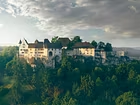
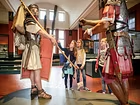
Children's museum and PLIRRK! Admission Museum entrance fee Notice The craft area closes at 4.30 pm. Children must be supervised. The paradise for knights and princesses! Children's museum The children's museum is located right up in the attic of Lenzburg Castle. There are lots of secret nooks and crannies, hidden staircases and oriels to explore. Children can dress up as knights or princesses, chase around the corridors and practise handicrafts and painting to their heart's content. Children's exhibition PLIRRK In the children's exhibition PLIRRK!, kids can immerse themselves in the world of

 
Habsburg Castle

Virtual Habsburg Castle

Virtual flight with VR glasses Admission Entrance free Booking required Book your time slot conveniently online. Please note The VR headsets are available at the visitor centre between April and October. Fly over Habsburg Castle as it was in 1200 Put your VR glasses on for an adventurous 360-degree flight over the castle in around the year 1200. Enjoy a bird's eye view of the site and immerse yourself in the world of the 13th century Habsburgs! Virtual Habsburg Castle: Fly over Habsburg Castle as it was in 1200

 
Wettingen Abbey

Guided tours for groups

Wettingen Abbey offers guided tours for groups. On request, they can also be organised in French. Offers for groups (in German) Contact +41 (0)848 871 200 Send a message Telephone availability: Tuesday to Friday 9 am - 12 pm / 1 pm - 4:30 pm November to March only in the morning

 
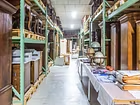
Egliswil Collection Centre

Guided tours and events

The Egliswil Collection Centre is not open to the public. From February to December a public guided tour takes place on the first Tuesday of each month. Event calendar (in German) Contact +41 (0)848 871 200 Send a message Telephone availability: Tuesday to Friday 9 am - 12 pm / 1 pm - 4:30 pm November to March only in the morning

 
Wettingen Abbey

Observatory

Permanent exhibition Admission Museum entrance fee Take a journey through the history of knowledge and belief At the Observatory, take a journey through the history of knowledge and belief in a cinematic installation. Together with a group of pupils from Wettingen Cantonal School, you will visit places that tell this story: from the earliest known cave paintings to the vastness of the World Wide Web. On this journey, you will discover how the monks of the Cistercian abbey understood knowledge in the Middle Ages – and how the expulsion of the monks from the abbey in 1841 was linked to new concepts

 
Wettingen Abbey

Medicinal garden

Admission Free of charge Tradition of monastic healing Today, medicinal herbs, spices, flowers and also certain vegetables grow in the medicinal garden of Wettingen Abbey. The garden showcases the long tradition of monastic medicine. The original location and design of the medicinal garden are not known in detail. It is assumed that, as in comparable abbey complexes, the Wettingen garden was located by the infirmary wing. The garden has been reconstructed at this location, based on the Hortulus book on gardening by the Reichenau abbot Walahfrid Strabo and the St. Gallen abbey plan from the 9th

 
Wettingen Abbey

Cloister garden

Admission Museum entrance fee Idyllic garden in the heart of the abbey complex Experience a special monastic atmosphere in the cloister garden of Wettingen Abbey: the idyllic garden with its meadow, yew tree, water basin and path is located within the abbey walls and surrounded by the cloister quadrangle. Throughout the ages, the cloister garden was designed as a spiritual garden with a central solitary tree. In monastic culture, the tree is reminiscent of the forbidden tree of knowledge in the Garden of Eden. On the other hand, it stands for life, as a symbol of Christ and the cross. Today's

 
Wettingen Abbey

Convent garden

Admission Free of charge English park, kitchen garden and plane tree avenue Discover secluded spots in the convent garden of Wettingen Abbey and stroll through the historic kitchen garden. A walk through the avenue, with its 200-year-old plane trees, is unforgettable. The convent garden – one of the first landscape gardens in Switzerland – extends from the abbey over three terraces down to the Limmat river. Fruit trees, a vineyard, a vegetable garden and a grotto invite you to stay a while. English park On the top terrace is the landscape garden designed according to the English model. The park is

 
Wettingen Abbey

Abbot's house

Permanent exhibition Admission Entrance free 0 Stately summer residence The stately abbot's house is situated to the south-west of the abbey, near the river Limmat. You can reach it by walking from the north through the front garden, which has been laid out in the traditional style. Built in 1726 by Abbot Alberich Beusch, the abbot's house served as a summer residence for him and his successors and as a place to receive guests. On the upper floor of the abbot's house, you'll find yourself in a charming living and study area, furnished with period pieces. An animated film projected onto the panelled

 
Wettingen Abbey

Abbot's garden

Admission Free of charge Stately summer residence of the head of the abbey Stroll through the abbot's garden at Wettingen Abbey, and imagine how the abbot once received his guests here. The garden extends over three terraces. Stone steps, walls, perennial beds and trellises give the "Gnädig-Herren-Garten" (as it is also called in Wettingen sources) a Mediterranean flair. The abbot's garden (or prelate's garden) was moved several times in the history of the abbey. At one time it was even located on the small island in the Limmat, until it was laid out at its present location as the garden of

Gradian
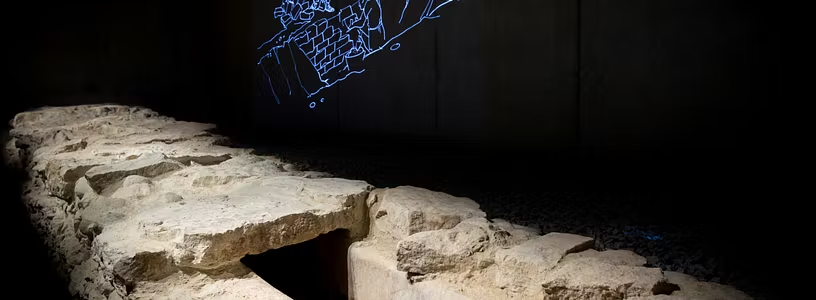
Erhaltene Wasserleitungen im Legionärspfad Vindonissa

Archaeological research

A whole series of spectacular finds

A whole series of spectacular finds

The soil around Vindonissa has been excavated and researched for more than 100 years in pursuit of archaeological evidence of the legionary camp and its civil settlement. Archaeologists repeatedly come across spectacular findings that provide fresh insights into what life was like 2,000 years ago.

The depots and archives now contain hundreds of thousands of items and archaeological information that sheds light on the world of the Romans in Vindonissa. Some of this treasure trove is now on show at the Vindonissa Museum in Brugg. In Windisch it is possible to view the structural remains dating back to the time of the legionary camp in the form of stations along the Legionary Trail.

The terrain in Windisch and Brugg continues to yield spectacular archaeological discoveries to this day. The most recent examples are the site of the eastern camp gate discovered by archaeologists of the canton of Aargau in 2014 and the previously unknown burial ground in Brugg-Remigersteig, which was unearthed in 2012. The burial ground at the foot of Bruggerberg was situated on the main road to Augusta Raurica. In addition to more than 140 graves, the excavations also brought to light an excellently preserved burial monument and the gravestone to go with it. The latter tells us that the grave belonged to Maxsimila from Bologna, who died at the age of 40, and her 10-year-old slave Heuprosinis.

Current excavations

Canton archaeologists are involved in a number of research projects relating to the Vindonissa excavation site. The Vindonissa Professorship for Roman Provincial Archaeology at the University of Basel Department of Classical Studies also makes an important contribution to research into the Roman site. A key focus here is collaboration with neighbouring scientific disciplines such as archaeobotany and archaeozoology.

For more information on current excavations in Vindonissa and elsewhere in Canton Argovia see Kantonsarchäologie Aargau (in German).