
Vindonissa Legionary Trail

Soldiers' quarters (Contubernia)

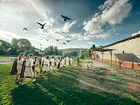
The accurately soldiers' quarters (contubernia) are absolutely unique in Europe and offer overnight stays for families, schools and groups. They have been reconstructed using wood, clay and limestone based on the methods that would have been deployed between 30 and 45 AD. During this period, the 13th Legion was stationed at Vindonissa with approx. 5,000 to 6,000 soldiers. The contubernia reproduced here were built entirely by hand – just as the legionaries themselves would have built the originals. The materials used, the construction techniques and the dimensions have been recreated as faithfully

 
Vindonissa Legionary Trail

Officer's kitchen (Culina Centurionis)

The residential building of a high-ranking officer with a surface area of some 1,100 m2 was situated directly on the main camp road running from east to west (via principalis). In pre-Roman times a huge trench from a Celtic fortification had been located here. The Romans removed the fortification wall and filled the trench so as to be able to build their camp on it. As the centuries passed the fill layers in the Celtic ditch gradually sunk down, causing the excavation layers from Roman times to subside as well. Go underground and explore this roman site Today, visitors to the Legionary Trail go

 
Vindonissa Legionary Trail

West Gate (Porta Principalis)

A legionary camp had four camp gates (portae), through which the two main roads led into the camp: the front gate (porta praetoria), the rear gate (porta decumana) and the two side gates (portae principales). The West Gate at Vindonissa was much more elaborately designed than the North and South Gate, featuring two large polygonal side towers. This was due to its position: it was here that the main roads from Gaul, Italy and Germania led into the camp. The two towers, whose foundation walls still survive, were octagonal in shape and would probably have extended to a height of some 20 metres

 
Vindonissa Legionary Trail

North Gate (Porta Decumana)

The discovery of the North Gate (porta decumana) in 1905 was a major breakthrough for early Vindonissa research. Any remaining doubts were finally dispelled: Vindonissa really had been a legionary camp and not a civil settlement. The gate is situated at the northern periphery of the Windisch plateau, directly above the slope running down to the River Aare. From here there is an impressive view to the north where the Aare cuts through the Jura Mountains. The Romans had clearly identified the outstanding strategic position of the plateau at the confluence of the Aare, Reuss and Limmat rivers and

 
Vindonissa Legionary Trail

Amphitheatre (Amphitheatrum)

The amphitheatre of Vindonissa is the oldest in Switzerland. It was erected by the 13th legion, initially being made of wood. After a fire, the 21st legion replaced it with the stone structure that survives today. The seating area (cavea) had a capacity of some 11,000 spectators while the oval arena in the centre measured 64x52 metres - the largest of the seven known amphitheatres on Swiss territory. The amphitheatre was a Roman invention that was widespread in the provinces and is regarded as the ultimate symbol of Roman culture. Animal hunting and slaying (venationes) and gladiator duels (munera

 
Königsfelden Abbey

Sammlung

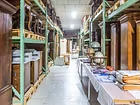
The Museum Aargau Collection has been assembled from various holdings since 1830. It consists of bequests from Aargau's castles and monasteries, numerous donations, objects acquired from company archives and targeted purchases. The Collection is constantly being expanded and documents Aargau's history in tangible form through objects that can be experienced. Collecting, preserving, researching Collecting, preserving and researching objects are among the core tasks of a museum. A collection strategy defines the criteria according to which objects are collected. When an object is added to the Collection

 
Vindonissa Legionary Trail

Contact

Legionärspfad Vindonissa – Museum Aargau Königsfelderstrasse 265 5210 Windisch Tel. 0848 871 200 Send a message Organisation Museum Aargau Management Member Contact Dr. Marco Sigg Director E-Mail Sibylla Fischer Head of Marketing & Communications E-Mail Rahel Göldi Head of Museum Programme E-Mail Andrea Lehner Head of Guest Services E-Mail Thomas Lüscher Head of Operations & Administration E-Mail Dr. Rudolf Velhagen Head of Collection & Conservation E-Mail

 
Wettingen Abbey

Parlatorium

Discussion Lab Admission Museum entrance fee Registration Not required (recommended for schools) Hundreds of questions in one room Built around 1600, the Parlatorium was one of the few rooms in the abbey where speaking was once permitted. Today, Museum Aargau invites visitors here to engage in conversation about faith, power and knowledge – and poses hundreds of questions on these topics. Choose one of them and embark on a journey of discovery through the Parlatorium: through conversation, play, or via interactive text, image and film installations. The exhibition was developed in collaboration

 
Wettingen Abbey

Cloister

Permanent exhibition Admission Museum entrance fee 0 A place of meditation with a significant series of stained-glass windows The well-preserved cloister, with its Romanesque and Gothic tracery, evokes the tranquillity that once characterised life within these walls. Small gravestones of monks buried here are set into the flagstone floor. At the heart of the cloister lies the idyllic cloister garden. The cycle of stained-glass windows in the cloister is particularly valuable. Private donors, friendly abbeys and the Swiss cantons have all donated these significant cabinet windows to Wettingen Abbey

 
Wettingen Abbey

Monks' church

Permanent exhibition Admission Museum entrance fee 0 Renowned for its richly carved choir stalls The monks' church forms part of the abbey church and was once accessible only to monks and clergy. It is renowned for its richly carved choir stalls: their clean, angular design is in keeping with the Renaissance style. If you look closely, you will discover some surprising motifs – such as a dog playing the flute, or a cat covering its ears. Objects from the abbey's history In the monks' church, Museum Aargau is exhibiting selected items from its collection, supplemented by significant loans from the

Gradian
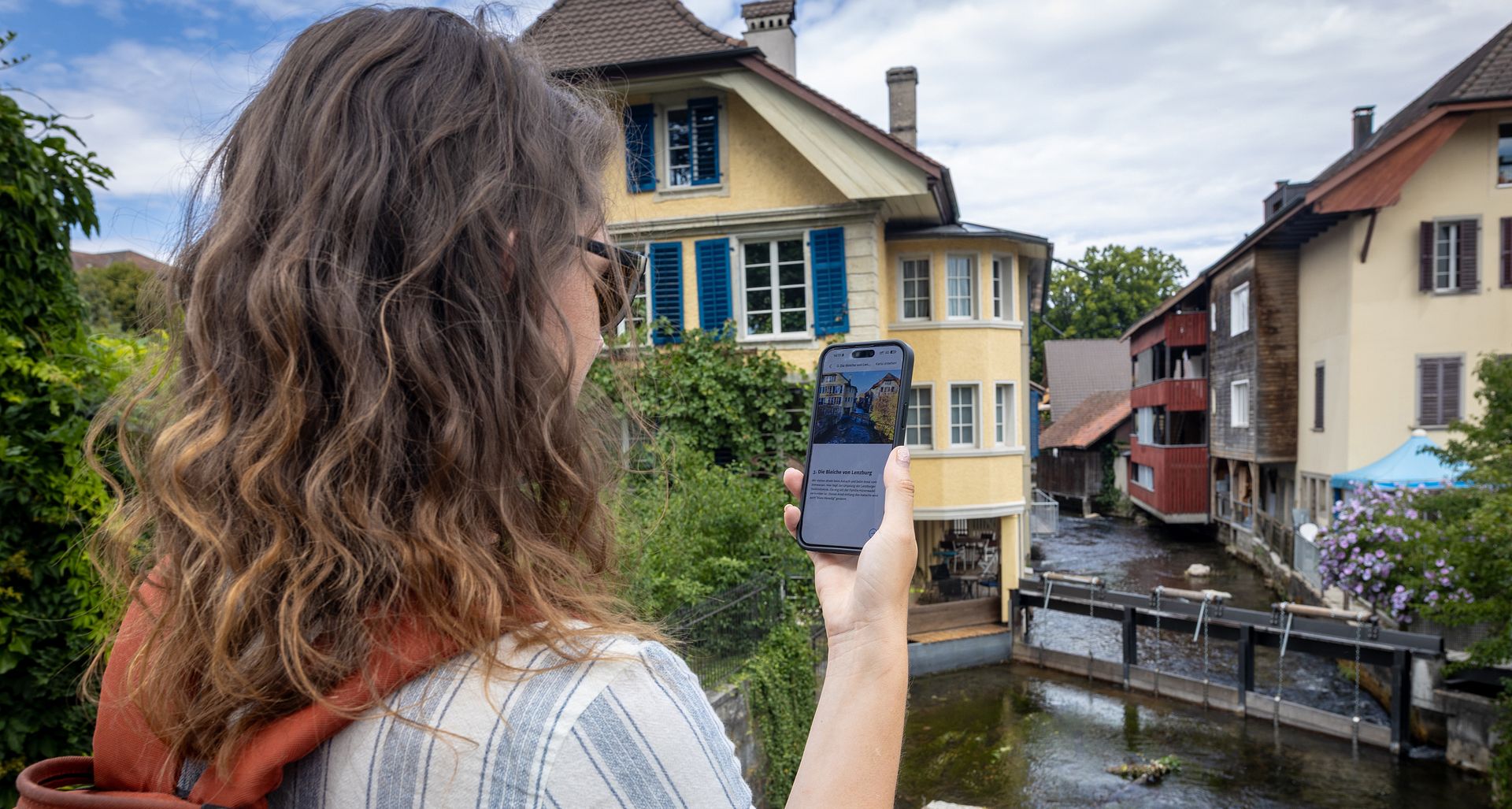
Eine Frau steht mit einem Handy in der Hand an einem Fluss.

IndustriekulTOUR Aabach

A Virtual Tour of Industrial History

Experience the industrial culture on the Aabach with your smartphone: the IndustriekulTOUR Aabach is the first virtual museum space in the canton of Aargau. The digital offering is available in German.

Start an exciting tour along the Aabach in Lenzburg, Wildegg and Niederlenz with your smartphone and experience the industrial history of the canton of Aargau at the original locations.

Download the app now

A cooperative project

IndustriekulTOUR Aabach is a cooperation between Museum Aargau, the Museum Burghalde and the Verein Industriekultur Aabach (both websites in German).

Enquiries and contact

+41 (0)848 871 200
museumaargau@ag.ch
Telephone availability
Tuesday to Friday
9 am – 12 midday