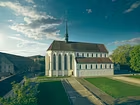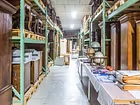

Egliswil Collection Centre

Contact

Sammlungszentrum Egliswil – Museum Aargau Binzenholzstrasse 10 5704 Egliswil Tel. 0848 871 200 Send a message Organisation Museum Aargau Management Member Contact Dr. Marco Sigg Director E-Mail Sibylla Fischer Head of Marketing & Communications E-Mail Rahel Göldi Head of Museum Programme E-Mail Andrea Lehner Head of Guest Services E-Mail Thomas Lüscher Head of Operations & Administration E-Mail Dr. Rudolf Velhagen Head of Collection & Conservation E-Mail

 
Vindonissa Legionary Trail

Tours to the Roman sites

From April to October, the Vindonissa Legionary Trail offers exciting expeditions to original Roman sites. Two tours are available in English. On a self-guided tour, you'll encounter atmospherically presented archaeological sites and true-to-life reconstructions, from the sunken officers' kitchen to the excavated thermal bath and the impressive remains of the amphitheatre. Travel back 2,000 years and experience the life of the legionaries and their officers. Most of the texts in the Roman sites have been translated into English. The Vindonissa Legionary Trail offers two tours in English (see below). Please also note our bookable offers for families , groups and schools . Some of these offers can also be booked in English on request. Please contact our advice & sales team for details. Opening hours 1 April to 1 November 2026 Tue – Fr: 9 am – 5 pm Sat/Sun, holidays: 10 am – 6 pm Mon: closed Impressions

 
Vindonissa Museum

Getting here by car, train and bus

Directions to Vindonissa Museum Address Vindonissa Museum – Museum Aargau Museumstrasse 1 5200 Brugg Tel. 0848 871 200 Contact Arrival by public transport and car Arriving by train and bus The Vindonissa Museum is well served by public transport. For larger events especially, we recommend travelling by train and bus. There are direct train connections from Zurich, Basel and Bern to Brugg. There are several bus lines to the museum. The nearest bus stop is "Brugg, Eisi", which is served by line 374 from the railway station. The Vindonissa Museum can be reached on foot in about 7 minutes. To the SBB timetable Arriving by car The Vindonissa Museum in Brugg is accessible via the A3 motorway: From Zurich: A3 motorway, Brugg exit From Bern: A3 motorway, Brugg exit From Basel: A3 motorway, Frick exit Calculate route with Google Maps Parking Paid parking is available in the Eisi car park next to the Vindonissa Museum (approx. 2 minutes' walk). Coach parking There are no parking spaces for coaches at the Vindonissa Museum. Opening hours & entrance fees Accessibility

 
Vindonissa Museum

Exhibitions

The Vindonissa Museum's exhibitions showcase the most important original finds from the excavations at Vindonissa. The permanent exhibition is translated into English. The only Roman legionary camp on Swiss soil was at Vindonissa. Excavations and research have been carried out here for around 100 years. The most important finds and discoveries can be seen in the exhibitions at the Vindonissa Museum. The museum is internationally renowned for the largest collection of Roman writing tablets, the most commonly used writing material of the Roman period. Other highlights include rare finds of leather and wood as well as well-preserved equipment belonging to Roman soldiers. Opening hours Open all year Tuesday to Friday: 1 - 5 pm Sunday and public holidays: 1 - 5 pm Monday and Saturday: closed

 
Vindonissa Legionary Trail

Excursions for families and children

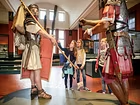
The Vindonissa Legionary Trail offers unforgettable experiences for children: discover the Roman sites of Vindonissa on your own or solve the riddle of the great oracle as a family in a play tour. Some of these offers are available in English. Families can discover the Legionary Trail on a self-guided tour. Most of the texts at the Roman sites are translated into English. There are also several picnic areas along the way. The Vindonissa Legionary Trail also offers the challenging " Becoming a Roman " (audio guide) play tour in English. This is suitable for families. Special events for children take place regularly on Sundays. Opening hours 1 April to 1 November 2026 Tue – Fr: 9 am – 5 pm Sat/Sun, holidays: 10 am – 6 pm Mon: closed

 
Vindonissa Museum

Contact

Vindonissa Museum – Museum Aargau Museumstrasse 1 5200 Brugg Tel. 0848 871 200 Send a message Organisation Museum Aargau Management Member Contact Dr. Marco Sigg Director E-Mail Sibylla Fischer Head of Marketing & Communications E-Mail Rahel Göldi Head of Museum Programme E-Mail Andrea Lehner Head of Guest Services E-Mail Thomas Lüscher Head of Operations & Administration E-Mail Dr. Rudolf Velhagen Head of Collection & Conservation E-Mail

 
Vindonissa Museum

Events

Experience the Vindonissa Museum at an event or public guided tour. Family afternoons take place regularly. Calendar of events (in German) Contact +41 (0)848 871 200 Send a message Telephone availability: Tuesday to Friday 9 am - 12 pm / 1 pm - 4:30 pm November to March only in the morning

 
Vindonissa Legionary Trail

Officer's kitchen (Culina Centurionis)

The residential building of a high-ranking officer with a surface area of some 1,100 m2 was situated directly on the main camp road running from east to west (via principalis). In pre-Roman times a huge trench from a Celtic fortification had been located here. The Romans removed the fortification wall and filled the trench so as to be able to build their camp on it. As the centuries passed the fill layers in the Celtic ditch gradually sunk down, causing the excavation layers from Roman times to subside as well. Go underground and explore this roman site Today, visitors to the Legionary Trail go underground where they come across the exceptionally well-preserved remains of this residential building. The "sunken" Mediterranean-style officer's kitchen with its large cooking stove is a particularly spectacular feature. The likewise well-preserved cooking waste and food remains have been archaeobiologically examined and show just what exquisite meals the chefs would prepare for the officer and his guests: roast suckling pig, songbirds, venison, Mediterranean mackerel and oysters were particularly popular – evidence of choice southern European cuisine in the middle of the Helvetian province. The Romans loved to throw lavish banquets followed by drinking sessions. These were private functions, the aim often being to impress guests by serving expensive, elaborately prepared dishes. But it was important to keep the simple soldiers amused, too not just the higher-ranking officers. Taverns were provided for this purpose. One such taberna was situated directly adjacent to the officers' residential building. For anyone staying overnight at the camp it was the perfect place to take a nightcap. This roman site can be visited with museum admission.

 
Vindonissa Legionary Trail

Soldiers' quarters (Contubernia)

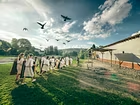
The accurately soldiers' quarters (contubernia) are absolutely unique in Europe and offer overnight stays for families, schools and groups. They have been reconstructed using wood, clay and limestone based on the methods that would have been deployed between 30 and 45 AD. During this period, the 13th Legion was stationed at Vindonissa with approx. 5,000 to 6,000 soldiers. The contubernia reproduced here were built entirely by hand – just as the legionaries themselves would have built the originals. The materials used, the construction techniques and the dimensions have been recreated as faithfully as possible down to the last detail. The scientific basis for this was provided by archaeological excavations at Vindonissa and other Roman military camps. Space was very limited A contubernium (shared barrack room or tent) consisted of two rooms. The legionaries used the front room to keep their weapons and equipment in, while the rear room was for living and sleeping. They would also cook in the contubernium as evidenced by the fireplaces found. Eight legionaries cohabited in a contubernium so space was very limited. Generally speaking, ten contubernia went together to form a soldiers' quarters (centuria). With a total of 80 men, the unit was commanded by a centurio or officer. His dwelling was at the head of a soldiers' quarters and was considerably larger and more comfortable than the legionaries' dwellings. Work which required space such as cleaning and repairing weapons was presumably carried out under the covered porch (porticus). In a legionary camp there were also large workshop buildings (fabricae) in which specially trained craftsmen soldiers (immunes) carried out various types of work such as fashioning wood, metal and leather. Alongside there were also smaller workshops (fabriculae) which were directly attached to the contubernia. The contubernia be visited with museum admission.

 
Vindonissa Legionary Trail

Large sewer (Cloaca Maxima)

The large sewer ran along the western front of the legionary camp, immediately adjacent to the camp wall. It lay under the road parallel to the camp wall (via sagularis) and formed part of an extensive subterranean sewage system. The system as a whole is estimated to have been more than five kilometres long, running through the entire camp. Built out of stone, the drains were used for the latrines, thermal baths and well overflows, also ensuring fast drainage of water from the roofs and roads when it rained. The large sewer collected the effluent from the smaller side drains, allowing it to flow directly out of the camp to the River Aare in the north. A functional drainage system was required so as to prevent the spread of disease and epidemics in the legionary camp. Together with the troop toilets, thermal baths and camp infirmary, the drainage system was one of the most important hygienic facilities in keeping the approx. 6,000 legionaries healthy and therefore fit for action. The large sewer was discovered as long ago as 1899. It was investigated once again in 1907 and the excavator at the time named it the "Cloaca Maxima of Vindonissa" – in reference to the monumental drainage system in Rome itself. In order to make the large sewer accessible to the public in the early 20th century, a section measuring at least 20 metres in length was preserved. After this the "Cloaca Maxima" was neglected. It was not until some 100 years later that it was possible to open up the drain to Legionary Path visitors: measuring two metres in height and one metre in width, it can be conveniently accessed. The large sewer can be visited with museum admission.

Gradian
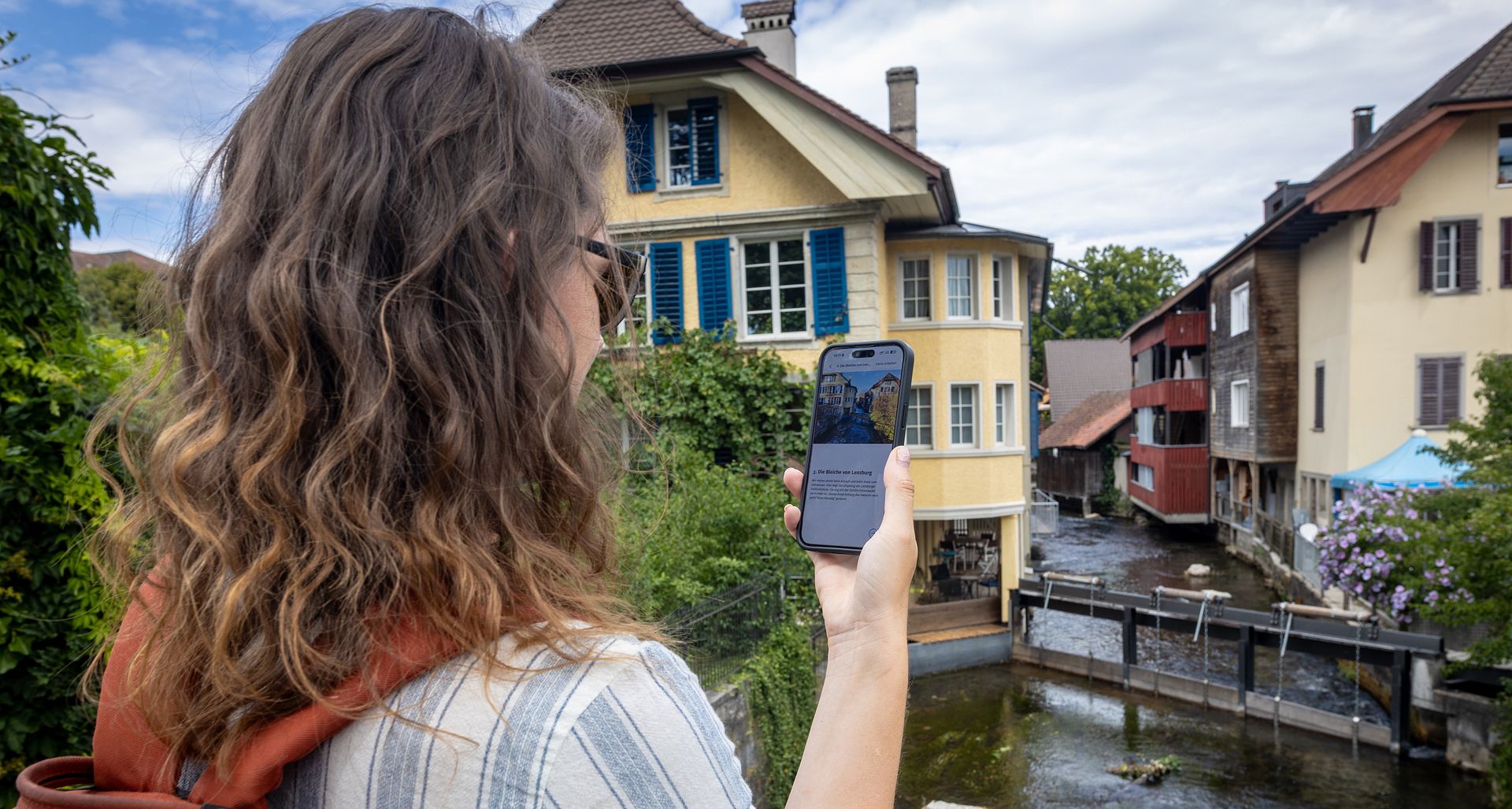
Eine Frau steht mit einem Handy in der Hand an einem Fluss.

IndustriekulTOUR Aabach

A Virtual Tour of Industrial History

Experience the industrial culture on the Aabach with your smartphone: the IndustriekulTOUR Aabach is the first virtual museum space in the canton of Aargau. The digital offering is available in German.

Start an exciting tour along the Aabach in Lenzburg, Wildegg and Niederlenz with your smartphone and experience the industrial history of the canton of Aargau at the original locations.

Download the app now

A cooperative project

IndustriekulTOUR Aabach is a cooperation between Museum Aargau, the Museum Burghalde and the Verein Industriekultur Aabach (both websites in German).

Enquiries and contact

+41 (0)848 871 200
museumaargau@ag.ch
Telephone availability
Tuesday to Friday
9 am – 12 midday