Wettingen Abbey

Medicinal garden

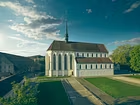
Admission Free of charge Tradition of monastic healing Today, medicinal herbs, spices, flowers and also certain vegetables grow in the medicinal garden of Wettingen Abbey. The garden showcases the long tradition of monastic medicine. The original location and design of the medicinal garden are not known in detail. It is assumed that, as in comparable abbey complexes, the Wettingen garden was located by the infirmary wing. The garden has been reconstructed at this location, based on the Hortulus book on gardening by the Reichenau abbot Walahfrid Strabo and the St. Gallen abbey plan from the 9th century. Medicinal garden on Wettingen Abbey. Tradition of monastic healing.

 
Wettingen Abbey

Cloister garden

Admission Museum entrance fee Idyllic garden in the heart of the abbey complex Experience a special monastic atmosphere in the cloister garden of Wettingen Abbey: the idyllic garden with its meadow, yew tree, water basin and path is located within the abbey walls and surrounded by the cloister quadrangle. Throughout the ages, the cloister garden was designed as a spiritual garden with a central solitary tree. In monastic culture, the tree is reminiscent of the forbidden tree of knowledge in the Garden of Eden. On the other hand, it stands for life, as a symbol of Christ and the cross. Today's cloister garden has been restored to how it was in around 1900. Cloister garden on Wettingen Abbey. Idyllic garden in the heart of the abbey complex.

 
Wettingen Abbey

Convent garden

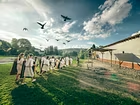
Admission Free of charge English park, kitchen garden and plane tree avenue Discover secluded spots in the convent garden of Wettingen Abbey and stroll through the historic kitchen garden. A walk through the avenue, with its 200-year-old plane trees, is unforgettable. The convent garden – one of the first landscape gardens in Switzerland – extends from the abbey over three terraces down to the Limmat river. Fruit trees, a vineyard, a vegetable garden and a grotto invite you to stay a while. English park On the top terrace is the landscape garden designed according to the English model. The park is famous for its valuable tree population: some of them date back to the 19th century, when the convent garden was laid out in its present form. Settle down in the shade of these trees and enjoy the view of the kitchen garden and the Limmat river. Baroque kitchen garden The Baroque kitchen garden extends over the middle terrace of the convent garden. Almost forgotten vegetable varieties and ecologically valuable mixed cultures grow here. Today, the vegetables are processed in the refectory of the cantonal school or sold in the abbey shop. The kitchen garden is laid out symmetrically and, in its present form, dates back to the early 19th century. The monks and lay brothers experimented here with the cultivation and propagation of different useful plants. Great importance was attached to gardening back when the teacher training college was here. Avenue of plane trees with grotto Like a fairy tale: there is no other way to describe this dreamy avenue with its plane trees, some of which are 200 years old. The Limmat river flows beneath the mighty treetops. A grotto adds a touch of mysticism to the avenue. Convent garden on Wettingen Abbey. English park, kitchen garden and plane tree avenue.

 
Wettingen Abbey

Abbot's house

Permanent exhibition Admission Entrance free 0 Stately summer residence The stately abbot's house is situated to the south-west of the abbey, near the river Limmat. You can reach it by walking from the north through the front garden, which has been laid out in the traditional style. Built in 1726 by Abbot Alberich Beusch, the abbot's house served as a summer residence for him and his successors and as a place to receive guests. On the upper floor of the abbot's house, you'll find yourself in a charming living and study area, furnished with period pieces. An animated film projected onto the panelled walls transports you back to the time of Abbot Peter Kälin in the mid-18th century. On the south side of the abbot's house, the abbot's garden slopes down towards the Limmat in a series of three terraces. A central flight of steps leads down into the terraces, which feature ornamental flowerbeds and a fountain. The stately abbot's house at Wettingen Abbey served as a summer residence.

 
Wettingen Abbey

Abbot's garden

Admission Free of charge Stately summer residence of the head of the abbey Stroll through the abbot's garden at Wettingen Abbey, and imagine how the abbot once received his guests here. The garden extends over three terraces. Stone steps, walls, perennial beds and trellises give the "Gnädig-Herren-Garten" (as it is also called in Wettingen sources) a Mediterranean flair. The abbot's garden (or prelate's garden) was moved several times in the history of the abbey. At one time it was even located on the small island in the Limmat, until it was laid out at its present location as the garden of the abbot's house at the beginning of the 18th century. As the summer residence of the head of the abbey, the garden served as a place to receive visitors. Abbot's garden on Wettingen Abbey. Stately summer residence of the head of the abbey.

 
Wildegg Castle

Living history museum and ancestral portrait gallery

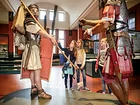
Permanent exhibition Admission Museum entrance fee Former castle residents are waiting to chat with visitors! Wildegg Castle is the castle of talking portraits: in the ancestral portrait gallery and the living history museum, former castle residents are waiting to chat with visitors. They include Julie von Effinger, the last owner of Wildegg Castle, who recounts anecdotes from her everyday life. Throughout the castle, large portraits of the von Effinger family come to life and tell of the past in a lively and entertaining way. An impressive living history museum With its more than 30 beautifully furnished rooms, Wildegg Castle offers a fascinating insight into the lives of the nobility and their servants. The banqueting hall, salon and dining room – complete with tables set for meals – state rooms as well as the kitchens and maids' quarters – as described by Sophie von Erlach-Effinger in the castle chronicle – can all be visited. You can also explore the narrow confines of the servants' rooms under the roof, visit the maid in the entrance hall, or sit on the windowsill like Julie von Effinger and gaze into the magnificent palace garden. Exhibition on Wildegg Castle: Living history museum and ancestral portrait gallery. Former castle residents are waiting to chat with visitors!

 
Wildegg Castle

Rose garden

Rose garden Admission Entrance free A major attraction for rose lovers The rose garden of Wildegg Castle is a major attraction for rose lovers. Numerous historical roses with rose arches, as well as English roses and hybrid tea roses, can be found here. Laid out in around 1830 it's a magnificent sight, especially during the main flowering period in June, replete with carefully tended, historical and rare roses. For weddings, the rose garden is a popular backdrop for photo shoots. It's also the perfect place to sit on a bench and read a gripping detective story. The small park near the historic wine cellar has been maintained free of charge for many years by the Aargau Regional Group of the Society of Swiss Rose Enthusiasts. Rose garden on Wildegg Castle: A major attraction for rose lovers!

 
Wildegg Castle

Vineyard path

Permanent exhibition Price Museum/garden admission 0 Nine interactive stations about viticulture The Wildegg Castle vineyard trail tells the story of the hard but rewarding work of winegrowers in centuries past. At nine interactive stations, built from old wine barrels, visitors discover the challenges of winegrowing: from tending the vines in winter to the dangers posed by weather, pests and diseases, right through to the grape harvest in autumn. Special attention is paid to the Effinger family, who used viticulture as their economic basis for centuries. Rebpfad Schoss Wildegg: Ausstellung über Weinbau

 
Wildegg Castle

Children's area and stables

Permanent exhibition Admission Museum entrance fee Saddle up the horses in the stables! Wildegg Castle is a paradise for families: children can play and paint in the castle barn, or saddle up the horses in the stables! Children's area: books, games and billiards There's never a dull moment in the children's area at Wildegg Castle! Here, kids can dress up as knights, set the table in the children's castle, browse through books on the elegant sofa or try out old games. They can even play a game of billiards – just as the residents of Wildegg Castle once did. Stables: saddle up the horses! In the old stables, Albert von Effinger talks to his favourite horse, while his hunting dog gives a running commentary! The wooden horses are waiting to be fed and groomed. In this exhibition, children learn what horses like to eat, how they were used in the past – and can even meet a talking horse. Sit side-saddle yourself, climb aboard the carriage, or race for the finishing line as a jockey! Exhibition on Wildegg Castle: Children's area and stables. Saddle up the horses in the stables!

 
Wildegg Castle

Hunting and game

Permanent exhibition Admission Museum entrance fee Stroke a wild boar! Stroke a wild boar and find out how the lords of Wildegg hunted with birds of prey and dogs around 1800. In the Jagd & Wild (Hunting & Game) exhibition you'll walk through the woods and stand amidst their animal inhabitants. You'll also learn which animals and tools were helpful to hunters, discover on a map where the hunting ground was located, and marvel at the many trophies that the Effingers brought home. In the lifelike hunting and game exhibition, Sigmund Effinger himself talks about his passion. His talking portrait explains why hunting was a privilege of the nobility and how everything changed in 1798. Exhibition "Hunting an game" on Wildegg Castle. Stroke a wild boar!