
Vindonissa Museum

Roman Garden of Vindonissa

Price: Included in the museum admission fee 0 Reconstructed Ornamental Garden of the Legion Commander The Roman garden at the Vindonissa Museum is an oasis of tranquility and sensory delight. A colorful array of plants flourishes in the flower beds, while water splashes in the fountains and basins. A colonnade frames the 450-square-meter complex, which is unique in Switzerland in terms of its size. The garden features around 40 plant species for which there is archaeobotanical evidence locally. The design, with its ornate bed borders and water features, is modeled after ancient examples and exudes a sense of opulent splendor. This is what the ornamental garden at the house of the legion commander might have looked like 2,000 years ago. Experience the Roman garden of Vindonissa: a unique oasis of tranquility featuring ancient plant species and splashing water displays.

 
Vindonissa Museum

Quiz Tour

Interactive tour for children Suitable for Ages 7 and over Price Included in the museum admission fee Duration 45 minutes Booking Not required 0 Trough the museum with the treasure map Our archaeologist on duty, Walter Scatterbrain, has been dreaming of grand palaces and glittering treasure again. He forgot where he stowed his latest finds from the last excavation. Help him find his objects and fill in the gaps in his diary. An exciting quiz for big and small. Join the quiz tour at the Vindonissa Museum! Help archaeologist Walter Schussel find his artifacts. A thrilling adventure for children aged 7+.

 
Vindonissa Museum

AKTUELL display

Admission: Museum entrance fee Highlights from the Cantonal Archaeology Department The AKTUELL display presents special treasures from the former legionary camp at Vindonissa. A new display is installed by the Cantonal Archaeology Department every year. Themes include current excavations, unusual finds and research results from throughout the canton of Aargau. The vernissage takes place every November.

 
Vindonissa Museum

Permanent exhibition on Vindonissa

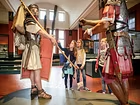
Admission: Museum entrance fee Discover original objects from excavations! How did the Romans live 2,000 years ago on the territory of present-day Switzerland? What did they eat? What weapons and clothes did they wear? For more than 100 years, archaeologists in the Brugg/Windisch area have been researching the site where the only legionary camp on the territory of present-day Switzerland once stood. Largest collection of Roman writing tablets The Vindonissa Museum shows original objects from these excavations in its permanent exhibition. It presents life and everyday routines in the legionary camp in various thematic areas and features the world's largest collection of Roman wooden writing tablets. The centrepiece of the exhibition is a three-dimensional model of the legionary camp, which gives a detailed view of the inside. With films, audio stories and games, the exhibition offers an interactive exploration of the Roman past of the Brugg/Windisch region. The texts in the permanent exhibition are translated into English.

 
IndustriekulTour Aabach

IndustriekulTour Aabach – Histoire industrielle virtuelle

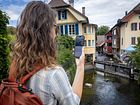
Experience the industrial culture on the Aabach with your smartphone: the IndustriekulTOUR Aabach is the first virtual museum space in the canton of Aargau. The digital offering is available in German. Start an exciting tour along the Aabach in Lenzburg, Wildegg and Niederlenz with your smartphone and experience the industrial history of the canton of Aargau at the original locations. Download the app now App Store (iPhone, iPad und iPod Google Play Store (Android) A cooperative project IndustriekulTOUR Aabach is a cooperation between Museum Aargau, the Museum Burghalde and the Verein Industriekultur Aabach (both websites in German). Enquiries and contact +41 (0)848 871 200 museumaargau@ag.ch Telephone availability Tuesday to Friday 9 am – 12 midday

 
Hallwyl Castle

Permanent exhibition

Permanent exhibition Admission Museum entrance fee Permanent exhibition on the family and construction history Who lived at Hallwyl Castle? When was it built? How did the lords of Hallwyl ensure law and order? And how did the servants live and work? The permanent exhibition in the castle provides an insight into the construction and family history and numerous aspects of the life of the nobility and their subjects. The topics range from agriculture and fishing to medieval medicine and the prevailing religion-based world view. Audiovisual shows, an audio guide, castle models to touch as well as chests and cabinets to open make the exhibition an experience for the whole family. Permanent exhibition on Hallwyl Castle. Permanent exhibition on the family and construction history

 
Wildegg Castle

Museum forest

Museum forest Price Entrance free Location The museum forest is located above the playground near Wildegg Castle. 0 Forest use in the 18th and early 19th centuries The museum forest at Wildegg Castle shows how forests were used in the 18th and early 19th centuries: as a larder, source of wood, grazing land and hunting ground. At the heart of the museum forest is the wood pasture. In early and late summer, goats graze here, just as they did 200 years ago. Guided tours and workshops bring this historical use of the forest to life and shed light on the highly topical issues of biodiversity and nature conservation. The museum forest at Wildegg Castle shows how forests were used in the 18th and early 19th centuries.

 
Wettingen Abbey

Parlatorium

Discussion Lab Admission Museum entrance fee Registration Not required (recommended for schools) Hundreds of questions in one room Built around 1600, the Parlatorium was one of the few rooms in the abbey where speaking was once permitted. Today, Museum Aargau invites visitors here to engage in conversation about faith, power and knowledge – and poses hundreds of questions on these topics. Choose one of them and embark on a journey of discovery through the Parlatorium: through conversation, play, or via interactive text, image and film installations. The exhibition was developed in collaboration with pupils from the Wettingen Cantonal School, which is also based on the monastery peninsula. Their perspectives on the themes of faith, power and knowledge build bridges between this place's past and the present day. At the weekend, school pupils usually welcome visitors to the Parlatorium. They have been trained as hosts for this role. The Parlatorium at Wettingen Abbey was one of the few rooms in the abbey where speaking was once permitted.

 
Wettingen Abbey

Cloister

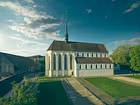
Permanent exhibition Admission Museum entrance fee 0 A place of meditation with a significant series of stained-glass windows The well-preserved cloister, with its Romanesque and Gothic tracery, evokes the tranquillity that once characterised life within these walls. Small gravestones of monks buried here are set into the flagstone floor. At the heart of the cloister lies the idyllic cloister garden. The cycle of stained-glass windows in the cloister is particularly valuable. Private donors, friendly abbeys and the Swiss cantons have all donated these significant cabinet windows to Wettingen Abbey. The earliest examples date back to the 13th century. Cloister Chapel with the Wettingen Christ Child Above the altar of the Cloister Chapel hangs the sacred image of the "Wettingen Christ Child". The wooden painting miraculously survived the devastating abbey fire on White Sunday in 1507. The monks saw this as a sign from heaven. The "Christ Child", marked by burn holes, has been venerated ever since. The cloister at Wettingen Abbey: a significant series of stained-glass windows. An exhibition by Museum Aargau.

 
Wettingen Abbey

Observatory

Permanent exhibition Admission Museum entrance fee Take a journey through the history of knowledge and belief At the Observatory, take a journey through the history of knowledge and belief in a cinematic installation. Together with a group of pupils from Wettingen Cantonal School, you will visit places that tell this story: from the earliest known cave paintings to the vastness of the World Wide Web. On this journey, you will discover how the monks of the Cistercian abbey understood knowledge in the Middle Ages – and how the expulsion of the monks from the abbey in 1841 was linked to new concepts of knowledge and power structures. Finally, you will return to the present day, amidst the challenges we now face in the "knowledge society". In addition, a timeline provides an insightful and varied account of the history of Wettingen Abbey. Selected objects also offer a glimpse into the collection of Museum Aargau. At the Observatory at Wettingen Abbey, take a journey through the history of knowledge and belief in a cinematic installation.

Gradian
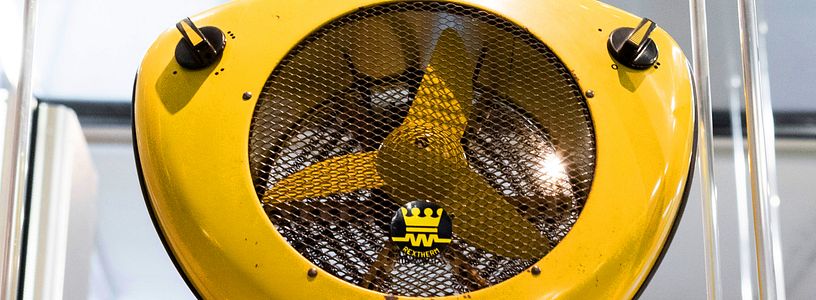
Ein gelber Heizlüfter, Objekt im Sammlungszentrum Egliswil

The Museum Aargau Collection

50,000 objects on the history of Aargau

50,000 objects on the history of Aargau

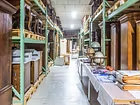
The Museum Aargau Collection comprises around 50,000 objects from 1000 BC to the present day. They are stored and researched in the Egliswil Collection Centre, where they are also presented during monthly guided tours.

The Museum Aargau Collection has been assembled from various holdings since 1830. It consists of bequests from Aargau's castles and monasteries, numerous donations, objects acquired from company archives and targeted purchases.

The Collection is constantly being expanded and documents Aargau's history in tangible form through objects that can be experienced.

Collecting, preserving, researching

Collecting, preserving and researching objects are among the core tasks of a museum. A collection strategy defines the criteria according to which objects are collected. When an object is added to the Collection, it is inventoried, documented and preserved for storage by experts. If necessary, it is restored. The objects thus form the basis for research and for exhibitions that use originals to make the past come alive.

The items on show in the permanent and special exhibitions of Museum Aargau (including the castles) and other cultural institutions are a mere fraction of what is stored in the Egliswil Collection Centre. Numerous objects are waiting to be exhibited and shown off to the public in the coming years.