Lenzburg Castle

Collection

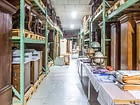
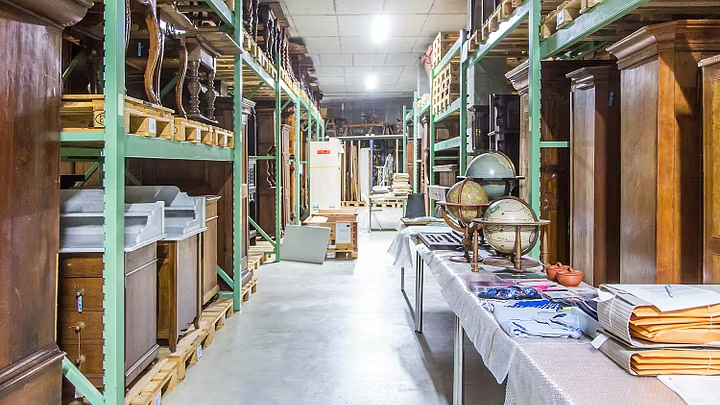
The Museum Aargau Collection has been assembled from various holdings since 1830. It consists of bequests from Aargau's castles and monasteries, numerous donations, objects acquired from company archives and targeted purchases. The Collection is constantly being expanded and documents Aargau's history in tangible form through objects that can be experienced. Collecting, preserving, researching Collecting, preserving and researching objects are among the core tasks of a museum. A collection strategy defines the criteria according to which objects are collected. When an object is added to the Collection, it is inventoried, documented and preserved for storage by experts. If necessary, it is restored. The objects thus form the basis for research and for exhibitions that use originals to make the past come alive. The items on show in the permanent and special exhibitions of Museum Aargau (including the castles) and other cultural institutions are a mere fraction of what is stored in the Egliswil Collection Centre. Numerous objects are waiting to be exhibited and shown off to the public in the coming years.

 
Lenzburg Castle

Exhibitions

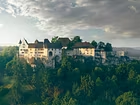
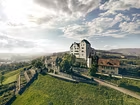
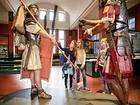
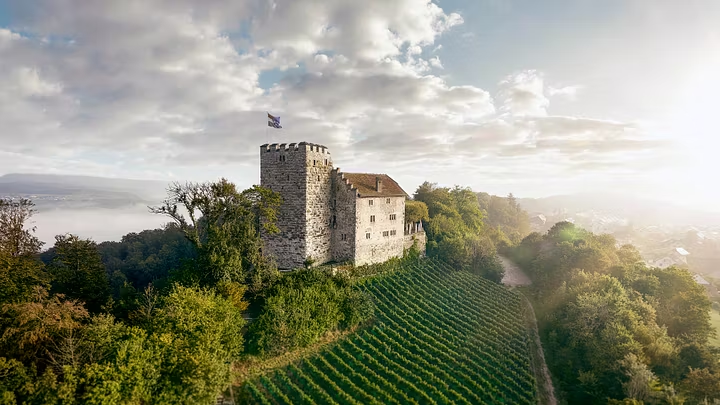
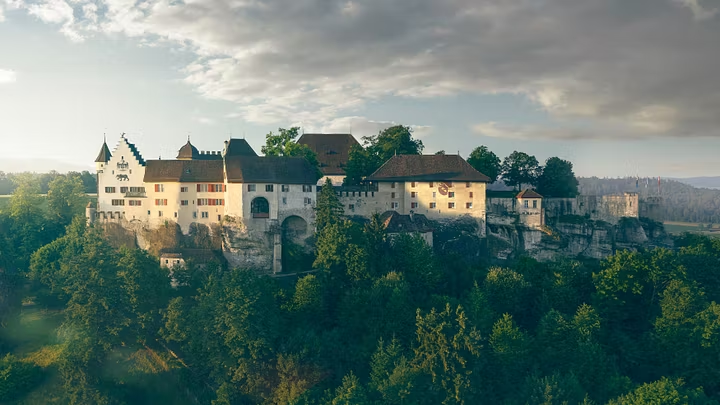
The museum and exhibitions at Lenzburg Castle explore 1,000 years of castle history. The texts are translated into English. Step over the drawbridge and immerse yourself in 1,000 years of history! The exhibitions at Lenzburg Castle are suitable for the whole family: the domestic life museum, for example, takes you on a journey through time from the Middle Ages to the 19th century. The original cells can be seen in the prison, where condemned criminals languished. In the children's museum, young visitors to the castle can explore secret corners. And don't forget to see Fauchi: the castle dragon is waiting in his cave for our braver visitors. Opening hours 1 April to 1 November 2026 Tue – Sun, holidays: 10 am – 5 pm Mon: closed COLLECTION Portrait Collection Site in German Collection online Egliswil Collection Centre Visit the collection Impressions

 
Lenzburg Castle

Bistro

The Mercure Hotel Krone runs the self-service castle bistro in the renovated Bernese House. The historic rooms and the beautiful outdoor area near the baroque garden are a great place to relax. The small restaurant is open to visitors with courtyard or museum tickets during museum opening hours. CHF, EUR and credit cards (including Maestro, Visa and Mastercard) are accepted. Menu and further information (in German) Offers from Museum Aargau to accompany your bistro visit Round off your visit to the bistro with a guided tour of Lenzburg Castle. We'll be happy to advise you. Guided tours and workshop for groups

 
Lenzburg Castle

Events

NOTE: MEDIEVAL MARKET This weekend (Friday through Sunday, September 11–13, 2026), the big Medieval Market will take place at Lenzburg Castle. More information (in German) Experience Lenzburg Castle! Events and public guided tours take place regularly at the castle. Calendar of events (in German) Contact +41 (0)848 871 200 Send a message Telephone availability: Tuesday to Friday 9 am - 12 pm / 1 pm - 4:30 pm November to March only in the morning Impressions

 
Lenzburg Castle

Contact

Address Schloss Lenzburg – Museum Aargau 5600 Lenzburg Tel. 0848 871 200 Send a message Organisation Museum Aargau Management Member Contact Dr. Marco Sigg Director E-Mail Sibylla Fischer Head of Marketing & Communications E-Mail Rahel Göldi Head of Museum Programme E-Mail Andrea Lehner Head of Guest Services E-Mail Thomas Lüscher Head of Operations & Administration E-Mail Dr. Rudolf Velhagen Head of Collection & Conservation E-Mail

 
Wettingen Abbey

History

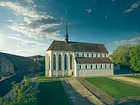
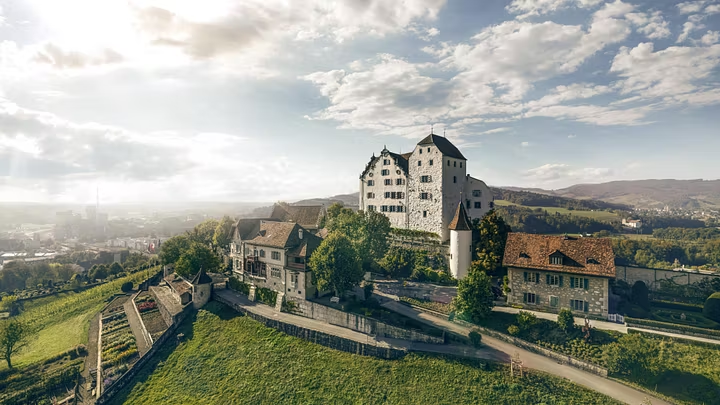
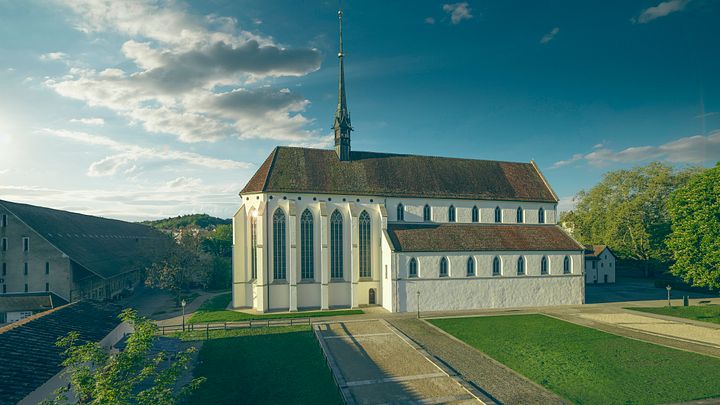
Foundation and construction of Wettingen Abbey The Cistercian Abbey of Wettingen was endowed in 1227 by Heinrich II of Rapperswil. Little is known about its foundation. Legend has it that, in distress at sea he called upon the Virgin Mary for help and promised her an abbey if he was rescued. The storm subsided. A bright star, the Maris Stella, appeared in the sky, which Heinrich interpreted as a sign from Virgin Mary. Count Heinrich of Rapperswil, tracing of a lost 17th-century mural in the cloister of Wettingen Abbey. (Zurich Central Library) Back home, it took him some time to find the place for "his" abbey at the bend of the Limmat river. After the land was purchased from the lords of Dillingen and the Cistercian General Chapter and the Bishop of Constance had given their approval, the abbey was founded. As usual, a mother abbey was sought, which sent some monks to the new abbey. Thus the first twelve monks came to Wettingen from the abbey of Salem near Überlingen. They began building the abbey complex. Life in the abbey The Cistercian Order emerged from the Benedictine Order in 1098. Some monks were dissatisfied with the development of the Benedictine Order. The Benedictine rules and the guiding principle of "ora et labora" had given way to wealth. First at Molesme, then at Cîteaux, many returned to the origins of monastic life. At the beginning of the 12th century, with the arrival of Bernard of Clairvaux, the Cistercians began to flourish. In addition to the monks, who devoted themselves primarily to prayer and contemplation, the institution of the converses, also called lay brothers, emerged. Thesey were responsible for the hard physical work in the fields, in the gardens and in the abbey. The Wettingen monastic community was also divided into these two groups. Often the monks were also ordained priests and responsible for the religious services in the surrounding villages. Agriculture was an important element of abbey life. Wettingen Abbey had a vegetable garden and a herb garden as well as vines. The abbot had a small private garden built around his house. The quiet cloister garden was a good place to meet for contemplation. Today these gardens have been partially reconstructed and can be visited. Difficult times in the 16th century After the abbey was almost completely destroyed by a devastating fire in 1507, monastic life was soon in danger again in 1529 due to the Reformation. Most of the monks converted to the new faith and married. However, until they could be financially independent, they continued to live in the abbey. A monastic life in silence and faith was no longer possible. No sooner did the Catholic monks have "their" abbey back than they were hit by another wave of plague. The abbey flourishes under Abbot Peter Schmid Peter Schmid was elected abbot of Wettingen Abbey in 1594. He assumed office determined to help the abbey flourish again. Many new buildings were erected. But he also laid down new rules to bring abbey life back into the community. Good education for the monks was very important to him. After 1651, the two Roman catacomb saints Getulius and Marianus provided the income. This purchase brought pilgrims to Wettingen and with them donations in the form of money. Wettingen Abbey in around 1710 (Cantonal Historic Monuments Preservation Department) Revolution and dissolution of the abbey The outbreak of revolution in France in 1789 ushered in a new era for everyone in Europe. "Egalité, Fraternité, Liberté" was the slogan. Everyone was to have the same rights and duties. The class order of the Middle Ages collapsed. Wettingen Abbey found itself in the middle of the war zone and had to accommodate numerous officers of all warring parties (French, Austrians, Russians). However, much more drastic was the scepticism of the revolutionaries towards religion. In the 19th century, this scepticism was also widely shared in the young canton of Aargau. The existence of the large and rich abbeys was an affront to many. In 1841, the Grand Council in Aarau resolved to dissolve Aargau's abbeys. Wettingen's monks had 48 hours to leave their home. It took 13 years for the Wettingen Cistercians to find a new home in Mehrerau near Bregenz in Austria. They still live there today. The abbey in modern times The abbey buildings were subsequently used as a teacher training college. The greatest advocate of the abbey’s dissolution, Augustin Keller, became rector of the school. He moved into the abbot's apartment and ran the teacher training college with the same rigour as abbey life had been run in the past. In 1976, Wettingen Cantonal School was founded, and has been housed in the former abbey premises ever since. More than 1,100 students attend either the secondary school or specialised school here. The Aargau teachers' seminar training college in Wettingen in 1864 (Aargau State Archives). Industrial culture The canton sold large areas and buildings on the peninsula to businessmen. Johann Wild founded a very successful cotton spinning mill on the Limmat, whose striking building is now used as a cultural and commercial centre. Former workers' houses are still inhabited today. Cultural heritage In addition to the richly decorated church, the cloister with its stained glass of figures and coats of arms is a striking feature. These stained-glass windows were created by outstanding craftsmen in Europe. They mostly came to Wettingen Abbey as a donation. Museum Aargau As of 1 April 2022, Museum Aargau will operate a museum in the exterior and in selected interior rooms. The museum's "School makes museum" project breaks new ground. There is no permanent exhibition to see, but an evolving display with interactive personal mediation of the topics of faith, power and knowledge. Pupils make museum concepts, realise them and carry them out. Aerial view of Wettingen Abbey from 1964. (ETH Library Zurich, Image Archive / Photographer: Comet Photo AG (Zurich) / Com_F64-02602 / CC BY-SA 4.0) Further reading Meng, Heinrich: 750 Jahre Kloster Wettingen 1227-1977: Festschrift zum Klosterjubiläum, 1977. Hoegger, Peter: Das ehemalige Zisterzienserkloster Wettingen, Kanton Aargau, GSK Band 604/605, Bern 1997. Hoegger, Peter: Glasmalereien im Kanton Aargau, Kloster Wettingen, 2002. Kottmann A., Hämmerle M.: Die Zisterzienserabtei Wettingen, 1996.

 
Wettingen Abbey

Event

 
Museum Aargau

The Collection

The Museum Aargau Collection has been assembled from various holdings since 1830. It consists of bequests from Aargau's castles and monasteries, numerous donations, objects acquired from company archives and targeted purchases. The Collection is constantly being expanded and documents Aargau's history in tangible form through objects that can be experienced. Collecting, preserving, researching Collecting, preserving and researching objects are among the core tasks of a museum. A collection strategy defines the criteria according to which objects are collected. When an object is added to the Collection, it is inventoried, documented and preserved for storage by experts. If necessary, it is restored. The objects thus form the basis for research and for exhibitions that use originals to make the past come alive. The items on show in the permanent and special exhibitions of Museum Aargau (including the castles) and other cultural institutions are a mere fraction of what is stored in the Egliswil Collection Centre. Numerous objects are waiting to be exhibited and shown off to the public in the coming years.

 
Museum Aargau

Contact & About us

Contact and reservation Phone 0848 871 200 Telephone availability: Tuesday to Friday 9 am - 12 pm / 1 pm - 4:30 pm November to March only in the morning Send a message Address Museum Aargau Schloss Wildegg Effingerweg 5 5103 Wildegg Organisation Museum Aargau Management Member Contact Dr. Marco Sigg Director E-Mail Sibylla Fischer Head of Marketing & Communications E-Mail Rahel Göldi Head of Museum Programme E-Mail Andrea Lehner Head of Guest Services E-Mail Thomas Lüscher Head of Operations & Administration E-Mail Dr. Rudolf Velhagen Head of Collection & Conservation E-Mail

 
Vindonissa Legionary Trail

Roman sites

ROMAN SITES Amphitheatrum Amphitheatre Porta Decumana North Gate Porta Principalis West Gate Contubernia Soldiers' quarters Culina Centurionis Officer's kitchen Aquaeductus Water main Cloaca Maxima Large sewer Aedes Flag shrine Balneum Baths Valetudinarium Military hospital Via et Porta Praetoria Main street and main gate HISTORY AND ARCHAEOLOGICAL RESEARCH History The only Roman legionary camp in Switzerland Archaeological research A whole series of spectacular finds

Gradian

Museum Aargau

Experience History in its Original Setting

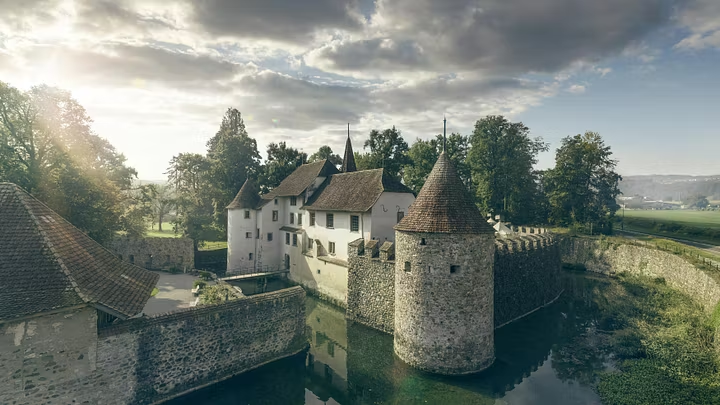
Museum Aargau is one of the largest historical museums in Switzerland. Experience four castles, a Roman camp, two abbeys, the Collection and industrial culture!